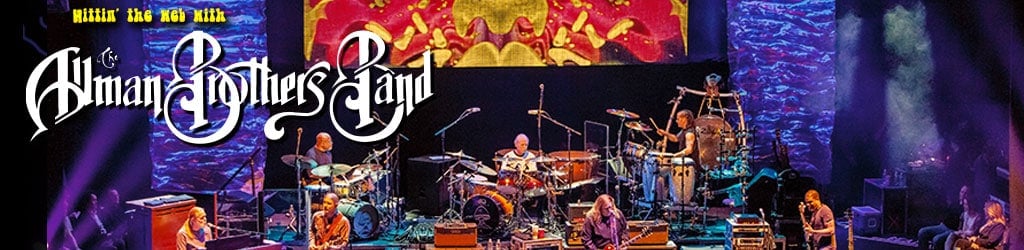


It's a beautiful warm evening in Birmingham and The Allman Brothers are heating up the night even more with a scorching version of Southbound, Nothing unusual there except that the standard twin guitar attack has been increased to four. Warren and Dickey having been joined by Duane Betts and Chris Anderson. Solos are being exchanged all around in every combination and Dickey is standing in the middle of it all like a rock & roll traffic cop directing soloing pairs until eventually all four guitars are unleashed.
At the lighting desk Earl Francis, lighting designer for The Allman Brothers Band, watches this stage intently. He has no way of knowing who may be soloing next or in combination with whom but his job is to make sure that whoever it is, is properly lit. Just another day at work for Earl since on this leg of the tour even the setlist, which was taped to the lighting console may as well get tossed into the trash can. It is Earl's job to make the unpredictable seem planned to provide a smooth and exciting light show which complements the music on the stage. And he has done it extraordinarily well for
a long time.
In an industry where venue crews traditionally are at odds with the band's crew Earl is just as likely to get a hug of appreciation from a member of the ABB as from a hard bitten member of the stagehands union at Madison Square Garden. As production manager Rich Kramer says, “He has a magic about getting a crew going. He has not pissed people off, he's done a great job, he's been friendly and got the job done and people like him. He's a very valuable asset to this band. I respect the man for many more things than just bringing the lights in.”
Besides The Allman Brothers Band, Earl has lit everything from Aerosmith to rap to corporate trade shows and supervised large shows transported by as many as 20 trucks. The Allman Brothers travel with three these days.
The day after the Birmingham show I sat down with Earl in Memphis in the production trailer at the Beale Street Music Festival and had the following
conversation.
Paul. Life on the road isn't a very conventional lifestyle how did you get involved in it?
EF. It may not be a conventional lifestyle for most people but once you get involved in it you know, I don’t think I could do anything else. I could do a regular job, but I don’t think I could enjoy it. When I was going to college I was going on the G.I. Bill, I needed extra money and a guy asked me if I could drive a truck and help set up and gear and I said sure. I finish college and just never got a regular job. This turned into my regular job. In the early years. I was doing bars and clubs driving the truck, setting up the gear, tearing it down, sleeping for two hours then driving to the next city and
doing the same thing. It’s just that eventually somebody likes what you do, you move to another band you go to a bigger band and you just stay like that.
Paul. What sort of pay would you get for a gig back then or were there times when you didn’t get paid for a gig? Did that happen?
EF. No there were times back then when we made more than the band because the band knew that we drove the gear set it up and went from day-to-day. They had regular jobs and we couldn’t, they went to school, but they would have to pay us or be ready to find somebody else. We were making like $250 a week and the band was probably making maybe $175 or $200 but they weren’t a real popular band. We were doing bars and stuff but you’d always get paid. The crew always got paid.
Paul. What sorts of bands were you doing back then?
EF. I did an old copy Genesis band, mostly copy material and I worked for a bunch of reggae bands for years. I worked for that first band for about eight years.
Paul. How did you first come to get hooked up with the Allman Brothers Band?
EF. They hired our lighting company, and it just progressed from there. It was on a bid type of thing.
Paul. And that was when?
EF. That was 1989.
Paul. So you were there from the beginning of the Dreams tour.
EF. Right but then I was just a crew chief rigger.
Paul. So what is your official title now?
EF. Crew chief rigger [laughs] and lighting designer, too many hats, but not really because you do the same thing, set up the gear. Make sure it all works. Even if I was just a lighting designer I would still be there to oversee everything so it doesn’t matter. I’m still there because most of the good lighting designers don’t oversee everything but you know no matter how good your crew is, you want to be there to make sure everything is all right. Make sure everything is safe.
Paul. Something that struck me the other night is that there is a lot of high tech equipment that’s meant to re-create the Fillmore atmosphere of 25 years ago.
EF. Yes. I don’t think you can ever re-create that. Their lighting was totally different. You know they had like four spotlights and six Fresnels [a type of lighting instrument] and the projection was done out front and it was in a smaller venue, but you can come close to it. What I try to do is assimilate the psychedelic era just on stage by letting the liquid light come through from the back screen and try to accent the band with the spots and leave the band in a sort of psychedelic pool of different colored lights and try to suck the crowd into it by having the moving lights go out into them.
Paul. So it sounds like you’re trying to coordinate what you’re putting on stage with the things the Brotherhood of Light are doing.
EF. Well you have to because it’s all part of the show, the music is the part of the show and we’re like the lungs and the other parts [laughs]. We feed the oxygen. Everything has to work together because a few times like on a low trim day playing a show in a venue with a low roof sometimes the projections just don’t produce and I’ll have to run my master down to make it. You just have to compensate all the time in other shows. It seems like the liquid lights just cut through anything and I can go full tilt I don’t know if it’s the atmosphere the humidity I don’t know what it is. We do use some
cosmetic smoke for effects and that doesn’t seem to affect it unless it’s overpowering.
We talk a little bit, but I just look at what colors they have and use the normal big rock ‘n’ roll colors the big red white blue green and I try to use the pastels because that blends a little bit more with them. I still have the regular rock ‘n’ roll red and amber, but I only have one power amber wash that can cut across with ACL’s [aircraft landing lights] for effect and like Southbound especially or Blue Sky on “you’re my sunny day” I’ll use it. It’s like a sunburst color too and that’s probably the only time I’ll use that set of lights the whole night. A lot of the lights up there are just used for one or two song specifically, and then other times they don’t even come on. I won’t even let an opening act use them because of that reason nobody else needs to see them.
Now on the moving lights if I use that as a straight beam coming down, that would real boring, especially like in Dreams or Back Where it all Begins. I get them to rotate and rotate colors and move a little bit and it just kind of adds to the psychedelic effect. But the main objective is to get the action coming from the screen I try to bring the crowd into it with the moving lights rotating through color because if you left them in white, like crap for a
heavy metal band, we don’t want that. We want the crowds to become part of this song, not to be blinded by it or shocked by it we want the crowd to dance and have a good time and become part of the music so I just use that in bits and pieces. I don’t try to overpower anything which lighting could.
Paul. You started to talk before about some of the band preferences, are there some things you're just not allowed to do, like lighting positions or colors that the band just does not want you to use??
EF. The fan doesn't like No Color bright in the face, but there are certain songs, I do. I hardly ever use No Color on Gregg except for introductions and after the show and after the encore. Otherwise I try to go with pastel on him so he doesn't get blinded by it. Actually, none of the players like the white bright follow spot in their face. But then there are a few songs I use it on, like I'll use an amber on Hoochie Coochie Man, and sometimes they'll break into the no color on Jessica on Dickey on his solo in there because there the no color is like Boom! But you don't leave a no color spotlight on any of the players. It really bothers them.
Paul. Speaking of follow spots, I'd like to talk about the mechanics of follow spots. You call follow spot cues also, in addition to calling the stage lighting cues.
EF. Right, that's the tricky part. Sometimes they can't hear you and sometimes the band will do a different song. I'll call up spot queues, tell them you want to be in this color, you want to be in home base, and then the band will do a different song. And Dickey will come in instead of Warren. And I'll have to change that around. So most times what I do is to come into a neutral color if I'm uncertain of what song they're going to play and add the spots on the solos. It looks like it's a little off beat or behind the time, but it's better than hitting the person with the wrong color. I have done that setup
thinking they're going to do one song and you're caught with your pants down. So it's better to come in with something like light lavender, open up on all of them and then add in the next spots in different colors and then add in the next spot. It's more fluid that way because some days the band will play every song verbatim right off the set list and then the next day they'll do the first 3 songs and the fourth song will be Oops! You can't get in the habit of being comfortable.
Paul. Speaking of which, tell me what happened during Southbound last night.?
EF. We just had a couple of extra guitars. [Laughs]
Paul. A couple of extra guitars! You didn't have enough follow spots to cover everybody, first of all. And second of all, the whole thing was a surprise, right? You didn't know that was going to happen until it did.
EF. Well, I know there's a possibility of that happening every night. So that's why we have overhead Lekos [another lighting instrument]. And I share one spotlight with a guitar player and a bass player. And I used Gregg‘s spot because in Southbound he doesn't sing. I used it on the other guitar players. And then I pick Greg up in an overhead lavender so everybody is covered, just everybody doesn't have a spotlight.
Paul. And when they started switching off on the solos you were doing some follow spot switching to accentuate who was actually playing.
EF. Instead of changing colors or that, I'll ask the spots to fade to 50%. All spots except one go to 50%. So it looks like you made a change but all you did was back the other spots down and it's a real easy move for them. They just doused down a bit and it dims the light coming out and you wait for the next person.
Paul. That's because the follow spot operators aren't travelling with the band, right? Those people are hired in every city.
EF. Some of them are union, some of them are not. Some days they'll be college kids. who have never run a spot before. You never really know. Some days you'll go to a college where they're all theater majors who've run spots and they're really good. The next day you get three people who never ran a spot. That's when you have the extra lights to cover in case somebody breaks down. Every day is different. Some days go along, like yesterday I lost AC to the console. In the middle of the concert, I'm like running around. I have my crew running around backstage and somebody just kicked the plug out. We put it back in and go back and you have to recompose. That's probably the hardest part to get back to where you were when the accident happened.
Paul. On the typical day, you're the first guy here because your equipment needs to go into the air before anybody else can come in.
EF. Well, in most bands that's true, but not for us. We go into production, a couple of sound guys will go in. We're pretty much like a family. We get up together and everybody goes in and works it out. We all have breakfast together in the morning. There are maybe one or two that don't go in early, but they're usually in before they have to be. It's not like well, they don' have to be there until 2:00, so I'm not going in. That's not the case. Everybody goes in like, well, what do we have to do today, where are we going to put the drum riser instead of ‘you should have put it here’. We try to avoid that by being a team because we've been together since 89. And some other crew members have been together a lot longer than that.
Paul. And then after things are over, you're the last ones to finish.
EF. Well. We try to be second, but usually we're last. [Laughs].
Paul. What do you need to do differently in terms of putting up and running a show under these street festival conditions as opposed to a situation like the Beacon Theater where it's you for a week or more?
EF. Well. Sound will go full tilt boogie. For me, I have to use a rig that I've never used before, so I'll run through it once when I'm able to see the lights because it's usually daylight when we set up. So once it starts getting dark, I'll go out and run through the lights and then I'll try to program the show with what's available as close to what they're used to and change the levels to avoid hitting the screen, because there will be a lot of ambient light from this street lights. And whatever they've got around it. So we try to adapt it and make it as similar as possible. I'll go in and refocus some of their lights a little bit because we have 3 drummers and all the drum lights may be set up for center stage and that won't work for us. So we have to touch all that up and once we get dark, I'll go out and touch them up again.
Paul. This shows are such high energy. Do you feed off the energy from the stage or do you feed off the energy from the audience and does that change the things you do?
EF. Well, I watch the stage. That's my only concern. The only time the crowd interferes with me is if there is a fight where somebody is coming at me. But I feed off the stage directly. Half the time I don't know. You can see that there's a crowd around me because I'm talking to people on the crew. I have to watch everything on the move. If they break a guitar string, I have to fade out. Spotlight, where if they change songs I have to watch which guitar they're getting. Is Alan Woody getting ready to go into Whipping Post? So my full attention is on this stage unless something drastically happens that takes my eyes off it.
Paul. This tour goes through this summer, so are you on the road all the way through the summer?
EF. Yeah, we're out March, April through September, then we'll be off for a few months. In the winter.
Paul. When the tour is over, are you going to relax or are you going to go out with another band?
EF. I'll do a few corporate shows, but not with another band because that will conflict with next season. Once you hook up with somebody, you make a commitment and we're going to continue on. Its easiest for me to do corporate stuff that's only for like 2 weeks, which is fine and I don't even care if I do that.
Paul. What do you like to do when you're not on the road?
EF. Camping, fishing. I work around the house a lot, a little gardening.
Paul. Where do you call home?
EF. Pittsburgh. Yeah it's nice there.
Paul. Is the production company based out of Pittsburgh.
EF. No, we're out of New Jersey. I lived there for 10 years before I started working with the band because there was a lot of work. You've got New York, you've got Boston and Philadelphia, all within 4 hours of travel. I used to work 11 months out of the year with just week breaks here and there. Doing all different types of events. And it was fine when you're younger, but now this is like home. You know when you're going to go to work, you know when you're going to be off, you know all the people you're going to be dealing with. We've been together so long, there isn't any real discomfort. Personality
conflicts. Everybody's got quirks, but you don't notice them or you don't mind them.
Paul. Are there any shows that stand out in your mind?
EF. The Hall of Fame and when we did Woodstock. The first time I saw the band was at Watkins Glen.
Paul. So you date back to at least 73 as an Allman Brothers fan.
EF. Yeah, I think everybody on the crew does! I used to listen to The Allman Brothers in Vietnam. I was there from 68 to 70.
Paul. That surprises me. I didn't think that they were that popular in Vietnam.
EF. Well, there were a lot of people from a lot of cultures over there. I mean, Jimi Hendrix was probably the biggest, but we got all different kinds of music. The Moody Blues were over there and we had the first Allman Brothers album. It was like, we gotta get home. Probably the biggest were Hendrix and Joplin and all of them. But people did listen to The Allman Brothers Band.
Paul. Sitting back in Vietnam, did you ever think you'd be doing something like this 25 years later?
EF. Well, not in ‘Nam, not even when I was beginning to go to college, I thought I was going to go into avionics. It was my main field and I just kept getting better jobs in music. So I’d be crawling around in the middle of an airplane, you know? Fixing stuff, running cables, and this was a little more enjoyable. And you get to travel and I enjoy traveling so I never even thought about changing jobs and college helped there for the electronics and working on gear, and now is even helping me more. Because the gear is becoming more computerized. You know, 25 years ago my electronics were like, oh man, I don't need any of this to work on the AC line. But now you have computer consoles, digital snakes running back and forth with DMX on each end, multiplexers. So now all my college from 20 something years ago was paying off. I just want to continue on and do lights for as long as I can. I don't have to retire when I'm 65. I can go on for as long as the band plays.
Paul. Hopefully that will be a very long time.
EF. Yeah, everybody's healthy and they're jamming. They're a couple of years older than me and I'm having trouble keeping up.
Paul. I don't know, I think you're doing pretty good. I saw you dancing last night. Do you usually do that?
EF. Sometimes when it really gets going, [laughs] like last night was a really good night. I was having fun. You see, we're just getting into the tour. There's another week of being out. We're going to know where every cable goes. We're going to know where every tape mark is, how far this has to be from that. And then it's just go for it. The first week or two weeks you're doing a festival; you're doing an arena or a theater. Everything's a little different. Will my cables work well, my dimmers work. After you do 3 of each type of show during the beginning of the season, you know the rest of the
summer. This goes with a festival; this goes in an arena. This is where this goes in a shed. You're going for it because every year the band gets a stage that's pretty much the same except for changing the height or the risers. But the lights do change because who wants to see the same basic thing over and over again? So I try to keep that changing. Little bit but it but still keep it basically the same. Still keep it fluid. Nothing really overpowering, but I think we should have a bigger production because the band deserves it.
Paul. What would you change about what's on stage now?
EF. I would make it more scenic. Make it more like the album covers out in the woods. Just add more scenery.
Paul. Instead of just the two big mushrooms.
EF. Yeah. Some scenery, because the mushrooms, we've used those for a few years now, so it's time to get something else. And the band is even talking about it now, so we may be getting that coming out on the next leg. We were talking about hanging scrims on the trusses and having scrims over the PA so you could make it more like the inside pictures of the first few albums where they took pictures of the band sitting in the woods.
Paul. Something with some graphics, not just black drape.
EF. Right. And I think they may wind up doing some of the front album covers, but the mushrooms are cool. We'll probably always keep them, you know, in a certain type of venue where we can't do new stuff we’ll bring those back on because they were done well. And I try to light them, try to make them move on a couple of songs, you know, get the mushrooms going. I don't even know if people are still doing psychedelics that much out there. [Laughs].
Paul. I'd be willing to bet there are a few.
EF. Yeah, [laughs again].
Paul. How does your philosophy of rock & roll lighting compare to the rest of the industry?
EF. Most people come to the shows and they see the band and they see the lights, but I think mostly they come to see the band. It's so common now with Genesis, with all the VariLites and everybody is used to the swinging lights around the arena and the giant mirror balls. Those are just effects. Mostly. They just come to see the band, I think because there's only so much you can do in lighting, and I think more thoughtfulness is adaptable to the bands rather than the high dollar productions people put on.
Paul. This isn't meant to be Pink Floyd.
EF. Right, Right. [laughs]. This is The Allman Brothers Band, Just come for the music and play all night.

Thank you for sharing this great interview, Paul! Love!